How to Keep Your Dog Socialized Without Dog Parks

Table of Contents
Why Dog Parks Aren't the Only Path to a Socialized Dog
What Socialization Actually Means
Dog Park Alternatives That Build Real-World Skills
Pet-Friendly Stores and Public Places
How to Introduce Dogs to Each Other Safely
Reading Stress Signals and Consent
Parallel Walking Dogs: The Low-Pressure Social Skill
Socializing an Anxious Dog Without Overwhelm
Find the Threshold, Not the Trigger
Adaptations for Reactive Dogs
Adaptations for Fearful Dogs
Adaptations for Senior and Disabled Dogs
When to Bring In a Professional
Meeting People, Children, and Strangers Calmly
Teach a Default Behavior First
The Three-Second Greeting Rule
Scripts for Strangers
Children Specifically
Older Adults and Unusual Approaches
What Not to Do
A Structured, Gradual Socialization Plan
Frequently Asked Questions
Last Updated: October 20, 2026
Why Dog Parks Aren't the Only Path to a Socialized Dog
Your dog does not need a dog park to stay a dog socialized through everyday life. A dog socialized through calm walks, controlled greetings, and steady exposure to everyday life often handles new situations better than one who learned everything in a fenced free-for-all.
Dog parks compress a lot of stimulation into a small space. That works for some dogs. For many, it teaches arousal, not manners.
What Socialization Actually Means
Socialization is the process of teaching a dog to stay calm and confident around people, animals, and new environments. It is not about meeting every dog in the neighborhood. It is about building neutral, relaxed responses to the world.
A dog who ignores a passing stranger politely is better socialized than one who drags you across the street to greet everyone.
The goal is a dog that can:
Walk past other dogs without lunging
Sit calmly while people pass
Handle new sounds, surfaces, and places without panic
Dog Park Alternatives That Build Real-World Skills
The best dog park alternatives teach skills a park never could: impulse control, leash manners, and comfort around distractions. Think of these as training grounds, not playdates.
Pet-Friendly Stores and Public Places
Hardware stores, pet supply shops, and outdoor shopping centers give you controlled exposure to people, carts, and noise. Keep visits short. Five to ten minutes is plenty for a young or nervous dog.
Walk the perimeter first, away from crowds
Reward calm behavior with treats
Leave before your dog gets overwhelmed
A good visit ends while your dog is still relaxed, not after the meltdown.
Pro Tip Call ahead to confirm a store allows dogs. Many national chains do, but individual locations set their own rules. A quick phone call saves you a wasted trip.
How to Introduce Dogs to Each Other Safely
To learn how to introduce dogs to each other without drama, the answer is distance and patience. A controlled introduction beats a face-to-face meeting every time.
Down 4 Paws Dog Training
Follow this sequence:
Start with both dogs on leash, 20 to 30 feet apart
Walk them in the same direction, parallel, never head-on
Close the gap slowly over several minutes
Allow brief sniffing only if both dogs stay loose
Break it off after a few seconds and walk away
Head-on greetings force a tense, direct approach; parallel movement feels natural and lowers the pressure.
Reading Stress Signals and Consent
Watch the body, not the tail. A wagging tail can mean excitement or stress. Look at the whole dog:
Relaxed: loose body, soft eyes, curved tail, easy movement
Stressed: stiff posture, tucked tail, lip licking, yawning, whale eye (showing the whites)
Overwhelmed: freezing, pulling away, growling, snapping
Consent in dog terms means both dogs can walk away. If one keeps trying to disengage, the greeting is over.
Watch Out Never let a leashed dog meet a strange off-leash dog. The leash removes the ability to flee, and a cornered dog is far more likely to snap. Ask the other owner to leash up or create distance.
Parallel Walking Dogs: The Low-Pressure Social Skill
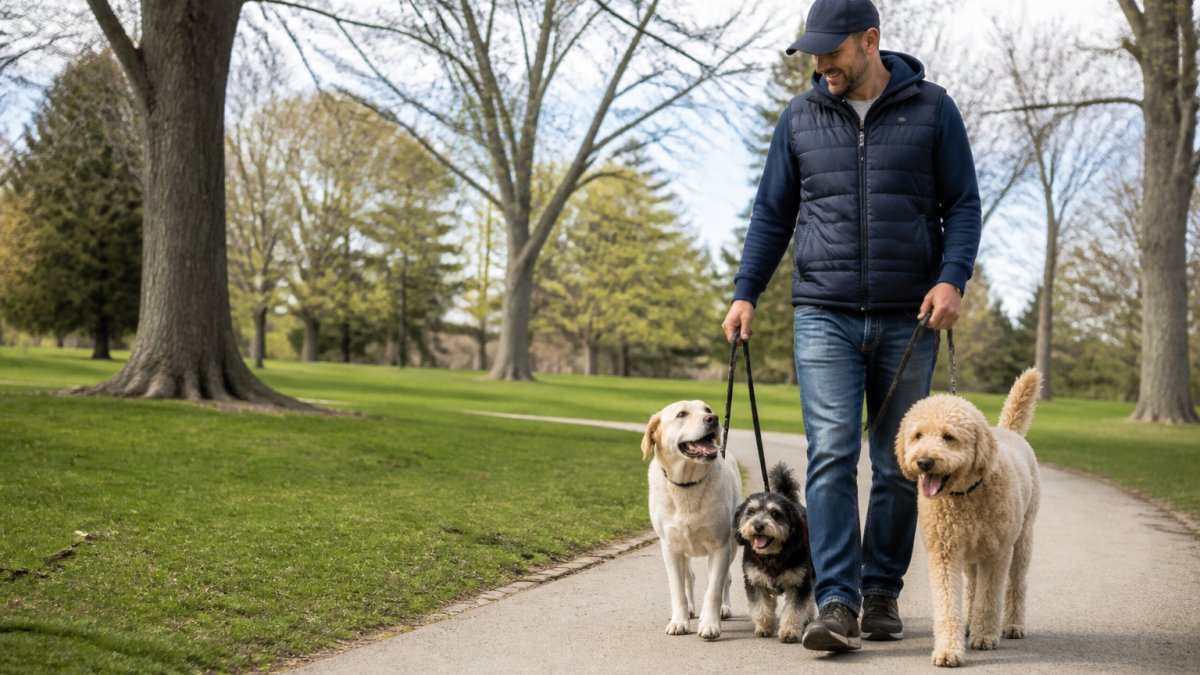
Parallel walking dogs means moving two dogs side by side at a comfortable distance without letting them interact.

Start with 10 to 15 feet between the dogs. If both stay relaxed, shorten the gap over several sessions; if either stiffens or stares, add distance back.
Socializing an Anxious Dog Without Overwhelm
Socializing an anxious dog works best in small doses, well below the point of panic. Push too hard and you teach fear, not confidence. This matters most if your dog is reactive, fearful, a senior, or has a disability that limits close contact.
Find the Threshold, Not the Trigger
Every anxious dog has a distance at which it can notice a trigger and still eat, sniff, and turn away. That is the threshold, work just inside it, never past it.
A practical way to find it:
Pick one trigger, a stranger, another dog, a skateboard.
Start far enough away that your dog notices but stays loose. If your dog will not take a treat, you are already too close.
Mark and reward calm looking (a glance at the trigger, then back at you).
Close the gap by a few feet only after three calm repetitions at the current distance.
If your dog stiffens, stares, barks, or stops eating, add distance immediately and end the session on a calm note.
This is desensitization paired with counter-conditioning, and it takes weeks, not days. Short five-to-ten-minute sessions beat long ones every time.
Adaptations for Reactive Dogs
A reactive dog does not need more dogs. It needs controlled distance and predictable routines.
Parallel walks at a distance. Walk on the opposite side of a wide street or a park path with a visible gap. Never let the dogs meet.
Visual barriers. Parked cars, hedges, and low walls let you practice passing triggers without a face-to-face encounter.
Pattern games. Simple games like treat-toss or "find it" give a reactive dog a predictable job when a trigger appears, which lowers arousal.
Adaptations for Fearful Dogs
Fearful dogs often shut down rather than react, which is easy to miss. Watch for freezing, a tucked tail, refused treats, or hiding. For these dogs:
Let the dog choose the pace. A fearful dog that approaches on its own is learning; one that is pulled toward a stranger is being flooded.
Use a long line in a quiet field to build confidence at a distance from people and dogs.
Reward curiosity, not contact. A dog that looks at a stranger and then back at you has just done the work.
Adaptations for Senior and Disabled Dogs
Older dogs and dogs with mobility or sensory limits can still stay socialized, the activities just change.
Senior dogs: short, sniff-heavy walks in familiar areas; quiet visits with calm, known people; avoid puppy-style playgroups that can injure aging joints.
Deaf dogs: use hand signals and a vibrating collar or a stomp on the floor to get attention; keep greetings visual and predictable.
Blind dogs: approach people and dogs from the front, announce yourself, and let the dog sniff before any contact. Sudden touches from behind are startling.
When to Bring In a Professional
If your dog has a bite history, lunges at people, or cannot recover from a trigger within a few minutes, work with a certified trainer or veterinary behaviorist. Look for credentials such as CPDT-KA or DACVB, and ask whether they use force-free methods, aversive tools can suppress behavior without addressing the underlying fear and often make reactivity worse.
Watch Out Never punish a growl. A growl is a warning, and suppressing it removes the warning without removing the fear. A dog that stops growling often goes straight to a snap.
Key Takeaway Progress for an anxious dog is measured in calm seconds, not new friends. A dog who can sit quietly while a stranger passes at 20 feet has made real gains, and that gain is what keeps the dog safe in the real world.
Meeting People, Children, and Strangers Calmly
People are a bigger socialization challenge than most owners expect. Children move fast and make noise. Older adults may reach out unexpectedly. Strangers loom. The fix is not more greetings, it is a repeatable protocol that gives your dog a predictable job when a person appears.
Teach a Default Behavior First
Pick one behavior your dog can perform on cue around people: a sit, a down, or a hand target. Practice it in the living room until fluent, then the front yard, then a quiet sidewalk. A dog cannot learn a sit-stay while a toddler is sprinting past.
The Three-Second Greeting Rule
Most practitioners recommend keeping every greeting under three to five seconds. The mechanics matter more than the number:
Ask the person to stand still and turn slightly sideways, a direct, square-on approach reads as pressure to a dog.
Let your dog choose to approach. If your dog hangs back, the greeting does not happen. That is a success, not a failure.
Allow one brief sniff of the back of the hand or pant leg, then call your dog away and reward.
End every greeting with movement, walk away together. Movement releases tension that builds during a static greeting.
Scripts for Strangers
Most people do not know how to greet a dog. Give them a short script so you are not managing your dog and a conversation at once:
"He's in training, please don't pet him, but you can toss a treat on the ground near your feet."
"She's shy. If you ignore her and keep talking to me, she'll come around on her own."
"Please don't reach over his head. Let him sniff your hand at his level."
Handing a stranger a treat to toss is one of the most effective tools available: it creates a positive association without a close approach and gives the stranger a job so they stop looming.
Children Specifically
Children are the hardest case because they are unpredictable, loud, and often at a dog's eye level. A few rules that hold up in practice:
Never let a child hug, kiss, or lie on a dog, even a known family dog. Most bite incidents involving children happen with familiar dogs during close contact.
Teach children to ask first, approach from the side, and pet the shoulder or chest, not the head or face.
Have your dog drag a light leash indoors during visits so you can separate calmly without grabbing a collar.
Older Adults and Unusual Approaches
Older adults, people with canes or walkers, and people in hats or uniforms can all read as unusual to a dog. Do not wait for a surprise encounter, practice with a friend wearing a hat, carrying an umbrella, or using a walker, and reward calm observation at a distance. A dog that has seen a walker at 30 feet is far better prepared for one at 10 feet.
What Not to Do
Never let a stranger pet a nervous dog "to help it get used to people." Flooding a fearful dog with forced contact usually backfires and can create a lasting negative association. The goal is not to collect greetings but to build a dog that can ignore people politely and engage when it is safe.
Key Takeaway A well-socialized dog is not the one that meets the most people. It is the one that can walk past a crowd, sit calmly while a stranger passes, and recover quickly when something unexpected happens.
A Structured, Gradual Socialization Plan
A structured plan beats random outings. Here is a simple weekly framework you can follow:
Week | Focus | Frequency | What Success Looks Like |
1 | Calm leash walks in quiet areas | Daily, 20 min | Dog walks past people without pulling |
2 | Parallel walks with a calm dog | 2-3 times | Both dogs stay loose at 15 feet |
3 | Pet-friendly store visits | 2 times, 10 min each | Dog stays relaxed near carts and people |
4 | Controlled greetings with known dogs | 2 times | Brief sniff, then walk away calmly |
5 | Busier public places | 2 times | Dog recovers from stress within a minute |
Track progress with a simple checklist:
Dog walks past a stranger without barking
Dog stays calm at 10 feet from another dog
Dog recovers from a startle within 60 seconds
The American Veterinary Medical Association's pet behavior resources offer solid guidance on reading stress and building confidence. The ASPCA's dog behavior tips cover positive reinforcement basics that support every step above.
For puppies, check with your vet before group outings. The CDC's guidance on dog bites and safe interaction is worth a read for any owner working on calm greetings.
Frequently Asked Questions
How can I socialize my dog without going to a dog park?
You can keep your dog socialized through structured leash walks, parallel walking with a calm companion dog, controlled one-on-one introductions, and visits to pet-friendly stores. These settings let your dog practice greeting, passing, and ignoring other dogs in a controlled way. Vary the environments and people your dog meets each week, and keep sessions short. A dog that practices calm behavior around distractions on a leash often builds stronger social skills than one that only free-runs in a crowded park.
How do I know if my dog is comfortable meeting another dog?
Watch the body language before and during the greeting. A relaxed dog has loose posture, a soft wagging tail, and ears in a neutral position. Warning signs include a stiff body, tucked tail, whale eye (showing the whites), lip licking, yawning, or trying to move away. If you see those stress signals, increase the safe distance and end the interaction. Consent in dogs looks like both animals choosing to approach and staying loose, not one pinned or frozen while the other pushes forward.
Can dogs be socialized without playing with other dogs?
Yes. Socialization is about calm, confident behavior around other dogs, people, and environments, not constant play. Many adult dogs do better with parallel walking, passing other dogs on leash, and coexisting in the same space than with rough play. Teaching your dog to ignore distractions, settle near others, and respond to commands builds social skills that hold up in real life. Playdates are optional; neutrality and confidence are the real goals.
What should I do if my dog is anxious around other dogs?
Start at a distance where your dog can still take treats and respond to you, then gradually decrease that distance over multiple sessions. Use positive reinforcement, keep greetings brief, and avoid forcing contact. A front-clip harness gives you more control on walks. If your dog shows reactivity, aggression, or panic that doesn't improve with gradual exposure, work with a certified trainer or veterinary behaviorist. For busy schedules, a consistent walker who understands your dog's temperament can reinforce calm routines.
Keeping a dog socialized takes consistency, and busy schedules get in the way. That is the problem Bark West solves for Park West residents. Steve the Dog Guy offers a flat rate of $20 for a 30-minute walk, on-call 24/7/365, with every walk customized to your dog's temperament and needs. Fully insured and bonded, Bark West works as your daily walker or your backup when plans change. Get started with Bark West and give your dog steady, calm socialization without ever setting foot in a dog park.
Contact

Comments